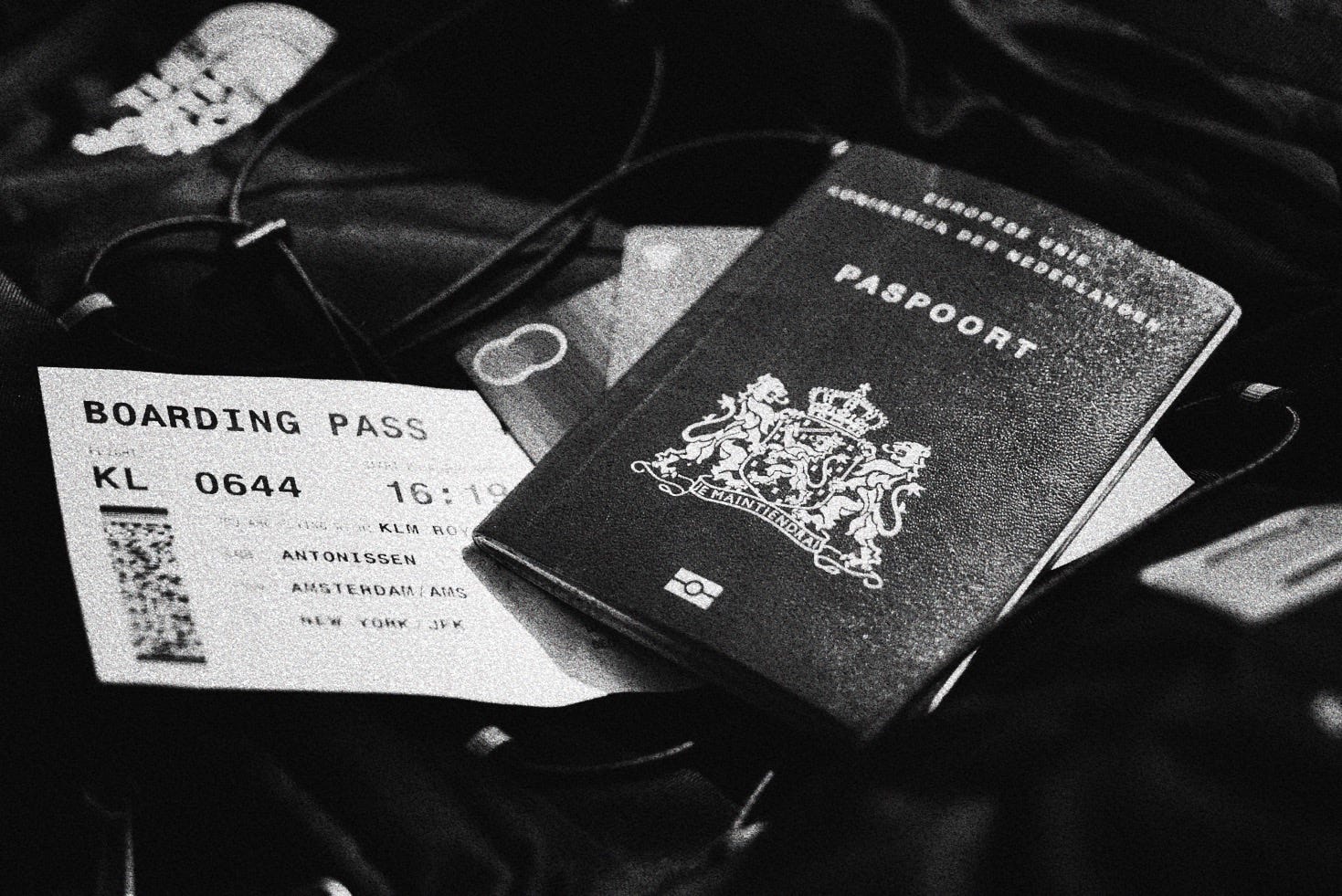
Plane to Catch
Two hearts. One ticket. Everywhere to go.

She was never looking for love. Not really.
Mostly, she was looking for quiet places in a loud city — bookstores with creaky floors, cafés where they knew her name, pockets of stillness where she could sip cinnamon lattes and underline lines that made her chest ache.
He walked into her life on a wind-chilled Wednesday in late September — all scarf and stubble and British vowels.
He was looking for the 6 train and asked her for directions outside McNally Jackson, but stayed when she said he was better off walking.
“New York isn’t meant to be rushed,” she said.
“I think it’s best discovered by accident.”
He laughed — a soft, surprised sound — and asked if she wanted to join him.
She said yes.
Because some part of her — the quiet, hopeful part — already knew:
two hearts
one ticket
everywhere to go.
That afternoon stretched into something weightless.
They walked block after block like they’d known each other in another life.
He told her he was from London, in the city for six weeks on a creative fellowship.
An illustrator. A quiet one.
She told him she wrote things she never let anyone read.
They stopped for espresso at a hole-in-the-wall café and shared a biscotti like it was something sacred.
When she had to go, he asked if he could see her again.
She said yes again.
It became a rhythm.
They weren’t the kind of couple who crashed into each other.
They unfolded, slowly — like a favourite sweater pulled from storage, a record you’d forgotten you loved.
Mornings became quiet rituals: two lattes, one park bench in Washington Square, shared headphones playing Bon Iver and Nina Simone.
They read books out loud in bed.
Made soup from scratch on Sundays.
Wrote notes on napkins and stuck them on the fridge.
She sketched her fears in the margins of her journal.
He painted her laughing.
By December, the trees were bare, but she’d never felt more full.
Still, there it was — always lingering — the flight he never talked about but hadn’t canceled.
January 17.
Return to London.
Back to the studio, the flat, the “real life” he left behind.
The night it snowed for the first time that winter, they stood on the fire escape in bare feet, watching the world go quiet under white.
She leaned her head on his shoulder and asked,
“What happens when you leave?”
He didn’t answer right away.
Just wrapped his arm around her tighter.
“I don’t want to,” he said, finally.
“I want to be wherever you are.”
That’s when the conversation shifted.
From what if?
To where to?
He’d always loved Amsterdam.
She’d always wanted to see it.
A city of bikes and books, canals and cobblestones.
A place that felt like it could hold new beginnings without erasing what came before.
They spent the rest of the week planning what to take, what to sell, what to say to people who wouldn’t understand.
And on January 17 — instead of standing alone at JFK — they stood together at the gate.
Two carry-ons.
Three notebooks.
No return flight.
Now, there’s a flat in the Jordaan district with crooked windows and a chipped blue kettle.
Books in every room.
Paintings on every wall.
She writes in the mornings.
He bikes to a nearby studio and draws until the light changes.
They meet for stroopwafels by the canal.
Sometimes they don’t talk. They don’t need to.
Home isn’t a place, she’s learned.
It’s a person who walks beside you when the map changes.
Every so often, when it rains just right, she thinks about the bookstore on Lafayette, the way the leaves looked the day they met.
Sometimes he reads her sketches and laughs.
“You really drew my nose like that?”
She smiles.
“Well, you didn’t cancel your flight,” she says.
He kisses her shoulder and replies,
“No. I just changed my destination.”
And somewhere between the cobblestones and the sky, between the words they write and the lives they’re building — they still know, as surely as they did that September day: Two hearts. One ticket. Everywhere to go.